Mitsubishi AC Making Strange Noises in Woodland Hills
Cut to it: A new Mitsubishi noise in Woodland Hills each points to a different fault - a buzz is electrical, a grind is urgent, a hiss can mean a refrigerant leak. Woodland Hills Mitsubishi HVAC diagnoses all four across 91364 and Carlton Terrace in the $89 to $3,500 range; call (213) 277-6575 or book online.
The rundown
- Loud buzz, no start: failing capacitor or chattering contactor, $150 - $450.
- Rattle: loose hardware, panel vibration, or condenser debris.
- Grinding or screeching: failing fan motor bearing or compressor - shut it down.
- Persistent hiss: possible refrigerant leak or sticking LEV/EEV.
- Bubbling near the drain: condensate path, check for P4/P5.
- Fan motor replacement runs into the $450 - $2,300 range.
- Service area 91364, 91367, 91371; debris noise spikes after Santa Ana winds.
- Independent diagnosis; in-warranty compressors to authorized service first.
What does each sound tell you?
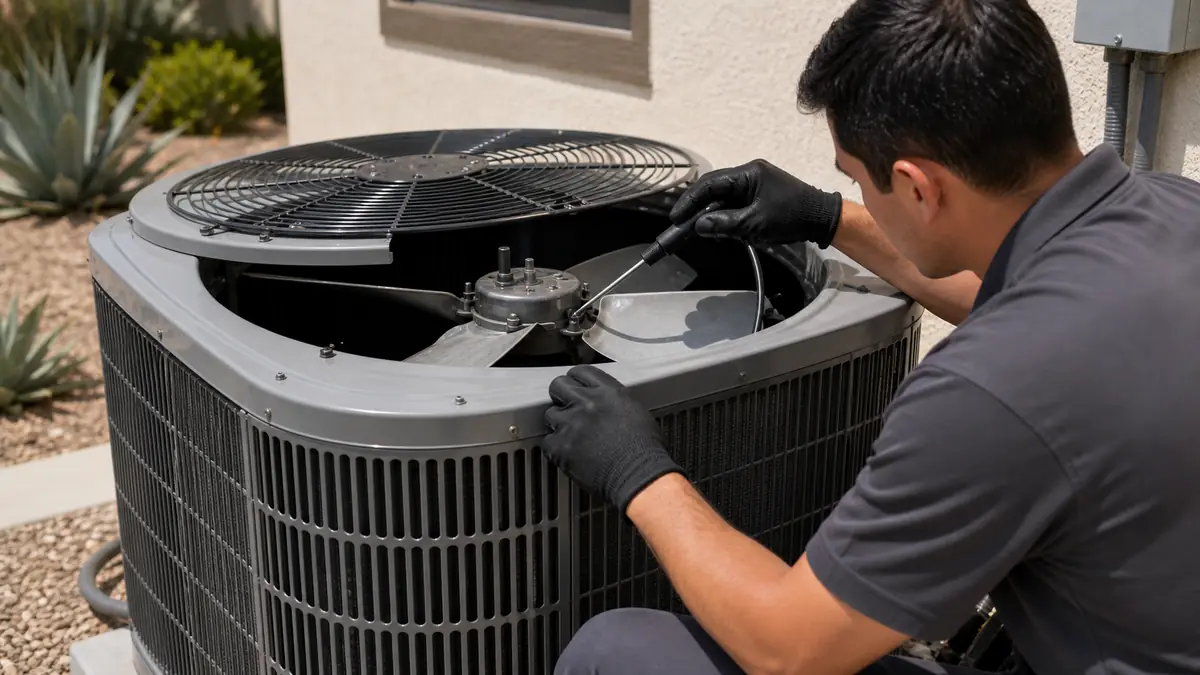
Different noises map to different parts, so the sound itself is a diagnostic shortcut. A loud electrical hum or buzz with no start almost always means the run/start capacitor is failing or the contactor is chattering - the compressor and fan are trying to start and cannot. A rattle is usually mechanical but minor: loose screws, a panel buzzing against the cabinet, or leaves and grit that blew into the condenser, which is common on Carlton Terrace and hillside lots after a Santa Ana blow. A grind or metal screech is the one to take seriously, pointing at a fan motor bearing or the compressor itself. A hiss or gurgle from an indoor head is often normal refrigerant flow through the LEV, but a loud persistent hiss can flag a leak.
| Sound | Likely cause / first check | Cost lane |
|---|---|---|
| Loud buzz, no start | Failing capacitor or chattering contactor | $150 - $450 |
| Rattle or vibration | Loose hardware, panel, or condenser debris | $89 - $300 |
| Grinding or screeching | Fan motor bearing or compressor fault | $450 - $3,500 |
| Persistent hissing | Refrigerant leak or sticking LEV/EEV | $225 - $1,500 |
Which noises can wait and which cannot?
A minor rattle from a loose panel or some debris is not an emergency - it can wait for a scheduled visit, though it is worth shutting off if something is clearly hitting the fan. The buzz-with-no-start should be addressed quickly because every failed start attempt stresses the compressor, but it is usually a fast, affordable fix. The grind or screech is the urgent one: keep running it and a $450 fan motor can cascade into a $3,500 compressor. During a Woodland Hills heat wave, that distinction matters - see emergency service if cooling is also failing.
How do we track down a noise?
We start by reproducing the sound and locating it - indoor head, line set, or outdoor unit - then test the obvious suspects: capacitor and contactor under load, fan blade and motor for play, hardware tightness, and refrigerant state if a hiss suggests a leak. We also pull any stored codes, since a noise often accompanies a logged fault. Most noises trace back to a part we can replace cleanly; the goal is to fix the cause, not silence a symptom. For electrical faults specifically, see AC repair, and to prevent debris and wear noises, a maintenance plan keeps the condenser clear.
What fault codes ride along with a noise?
A Mitsubishi rarely makes a serious noise in silence on the control side - the inverter usually logs something at the same time, and reading it shortens the diagnosis. A grinding outdoor fan that is also dragging the inverter can throw U8 (outdoor fan motor) or, if the motor stall pulls current, U6 (compressor overcurrent / inverter). A compressor that is laboring and overheating before it gets loud can set U2 (high discharge temp) or U3 (discharge thermistor). A loud hiss that turns out to be a flare-joint leak often pairs with U7 (low discharge superheat) or P8 (abnormal pipe temperature) once the charge drops far enough. A buzzing head that will not start and shows E6 or E7 is a communication fault on the S1/S2/S3 line, not a mechanical noise at all. We read the green-LED blink count or the kumo app, match the code to the sound, and confirm with instruments rather than guessing from the noise alone.
| Sound | Possible code | What we confirm |
|---|---|---|
| Grind or screech, outdoor | U8, U6 | Fan motor bearing play, inverter current draw |
| Labored hum before shutdown | U2, U3 | Discharge temp and thermistor reading |
| Persistent hiss, weak cooling | U7, P8 | Superheat, pipe temp, flare-joint leak search |
| Buzz, head will not start | E6, E7 | S1/S2/S3 wiring and control board |
What can you safely check before calling?
A short list is safe for a homeowner with the system powered down. Look for an obvious loose access panel or a screw you can hand-tighten, and clear leaves, mulch, or a stray sprinkler line that blew against the condenser - common on Carlton Terrace lots after a Santa Ana. Note the exact character of the sound and when it happens (at startup, all run, only on shutdown) and read any code on the controller or kumo app. What you should not do: open the electrical compartment, touch the capacitor (it stores a charge even with power off), or pull the fan to inspect a bearing. Anything electrical, refrigerant, or compressor-related is a gauges-and-meter job for a tech. A loud buzz with no start lands in the $150 to $450 capacitor or contactor lane, a fan motor in the $450 to $2,300 range, and a compressor-level grind can reach $1,200 to $3,500 - which is exactly why catching the screech early, before it cascades, saves the most money.
Common questions
My outdoor unit buzzes loudly but does not start. What is it?
A loud electrical buzz with no start is classically a failing capacitor or a chattering contactor at the MUZ condenser. Shut the system off so you are not repeatedly stressing the compressor against a bad start component, and call. This is usually a quick fix in the $150 to $450 lane once we confirm it.
What is the rattling on my Mitsubishi outdoor unit?
Rattling is often loose hardware, a panel vibrating against the cabinet, or debris that blew into the condenser - common on hillside lots and after Santa Ana winds. Sometimes it is a failing fan motor bearing. We isolate whether it is cosmetic hardware or a real mechanical fault before recommending anything.
Is a grinding or screeching sound serious?
Treat it as serious. Grinding or metal-on-metal screeching usually points to a failing fan motor bearing or a compressor issue. Running it can turn a motor replacement into a compressor replacement, so shut it down and have it diagnosed quickly, especially during a heat wave.
Why does my indoor head gurgle or hiss?
A faint hiss or gurgle from a wall head is often refrigerant moving through the LEV and lines and can be normal. Persistent loud hissing, though, can indicate a refrigerant leak or a sticking expansion valve, which we confirm with gauges. A bubbling sound near the drain points at the condensate path.