Mitsubishi E6 Error Code in Woodland Hills
Cut to it: A Mitsubishi E6 error in Woodland Hills, CA (ZIP 91364) means the indoor and outdoor units lost communication over the S1/S2/S3 line - usually a loose or corroded terminal, not a dead board. Woodland Hills Mitsubishi HVAC meters the inter-unit signal end to end and quotes the real fix; call (213) 277-6575 or book online.
The rundown
- E6 (and the related E7) is an indoor-to-outdoor communication fault.
- Most common root cause: a loose or corroded S1/S2/S3 terminal.
- Symptom pattern: head runs and blows, but the compressor never starts.
- Diagnosed by metering the signaling voltage at both ends and the cable between.
- Wiring or terminal repair: within a $79 to $200 visit.
- Failed indoor or outdoor control board: about $400 to $2,000 installed.
- Service area 91364, 91367, 91371; independent diagnosis.
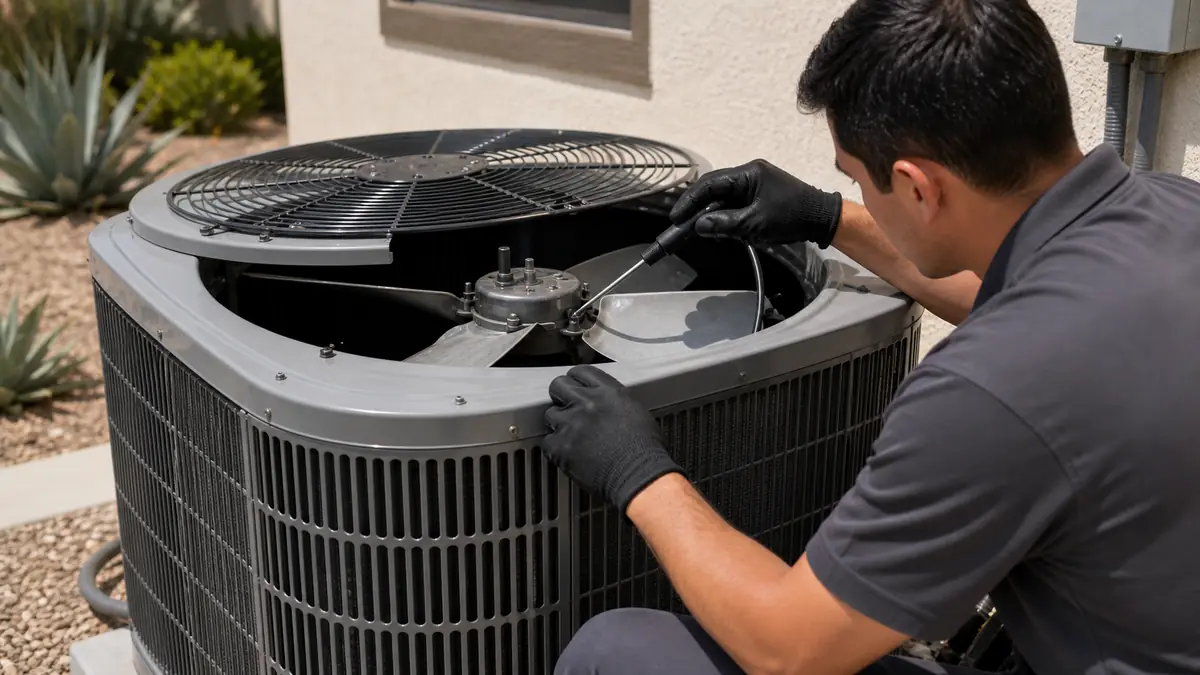
What does the E6 code mean on a Mitsubishi?
E6 is Mitsubishi Electric's way of saying the two halves of your system have lost their conversation. The indoor head and the outdoor condenser trade a continuous digital signal over the three-conductor S1/S2/S3 cable: S1 and S2 carry power between the units and S2/S3 carry the communication. When the indoor board stops receiving a valid reply from the outdoor unit for long enough, it latches E6 and refuses to call for the compressor as a protective measure. That is why the classic complaint is a head that powers on, lights up, and blows room-temperature air while nothing happens outside. E6 lives in the same family as E7 and a few related communication codes; they all point at the link between the units rather than at the refrigerant circuit itself.
Why does E6 happen in Woodland Hills homes?
The pattern here is tied to how these systems got installed and where they live. Most Woodland Hills Mitsubishi systems are retrofits into mid-century ranch and split-level homes that were never wired for ductless, so the S1/S2/S3 cable was run after the fact - often surface-mounted along an exterior wall, up through a Walnut Acres eave, or stapled across a hillside crawl south of Ventura Boulevard. Long, exposed runs invite two failures: terminals that work loose as the line set heats and cools through the far-western Valley's daily swing, and corrosion where the damp air that does slip over the Santa Monica Mountains reaches an outdoor lug. Add the occasional landscaper's trimmer nicking a cable or a rodent in a Vista de Oro attic, and you have the bulk of the E6 calls we run. The boards themselves fail too, but less often than the wiring that feeds them.
How do you diagnose a Mitsubishi E6, step by step?
We work from the cable outward so the verdict rests on meter readings, not on swapping parts. First we kill power at the disconnect and confirm the outdoor unit even has line voltage - an open disconnect or a tripped breaker mimics E6. With power restored, we set a multimeter to AC volts and read across the outdoor S1-S2 terminals for supply, then watch S2-S3 for the fluctuating communication voltage that proves the outdoor board is transmitting; a steady or dead reading there points at the outdoor PCB. Next we read the same terminals at the indoor head. If the signal is healthy outside but absent or degraded at the head, the cable or a terminal in between is the fault, and we ohm the conductors end to end to find an open or a high-resistance joint. We also pull and inspect every terminal: a lug that looks landed can still be loose under the screw or green with corrosion. Only when the readings point at a board - dead transmit at a unit that has good power and good wiring - do we condemn one.
What can I safely check before calling?
There are a few honest, no-risk checks a homeowner can make. Confirm the outdoor disconnect by the condenser is fully seated and the breaker has not tripped. Walk the visible run of the inter-unit cable and look for obvious damage - a chewed jacket, a kink where a gate pinches it, a section a trimmer scored. Power the system fully off at the breaker for two minutes and back on; a one-time communication glitch may not return. What you should not do is open the terminal-cover plates and probe the lugs: S1/S2/S3 carries line voltage, the screws are close together, and a slip can short and kill a board that was fine. If the reset does not hold, that is the line where it becomes a pro job. Our techs carry the meters and the common boards, so an E6 that turns out to be wiring is frequently a single-visit fix.
What does the E6 repair cost, and when is it urgent?
Cost tracks the root cause. Re-landing a loose wire, cleaning a corroded terminal, or splicing a damaged cable generally falls inside a $79 to $200 diagnostic visit. A failed indoor or outdoor control board, or an inverter board on the condenser, runs about $400 to $2,000 installed depending on the model - which is exactly why we confirm where the signal dies before quoting one. On urgency: an E6 is not a safety hazard the way a gas or burning-wire fault is, but during one of the far-western Valley's stretches over 90 F, a system that blows but will not cool is a same-day call for a home with anyone elderly, very young, or medically fragile. If you also smell burning, see a tripping breaker, or spot scorched insulation at a terminal, shut it off and use our emergency service. For the full code family, start at the Mitsubishi error-code reference, or book a standard Mitsubishi AC repair visit.
Common questions
What is the Mitsubishi E6 error code?
E6 means the indoor unit has stopped receiving a valid signal from the outdoor unit over the S1/S2/S3 inter-unit line. The head usually still powers up and runs its fan, but the compressor never comes on, so you get air with no cooling or heating. It sits in the E6/E7 communication family and points at wiring, terminals, or a control board.
Can I fix an E6 error myself?
You can safely check the obvious things with the power off: confirm the outdoor disconnect is on, look for an obviously chewed or pinched inter-unit cable, and reset power once. Beyond that, opening the terminal covers and metering S1-S2-S3 is pro work - those terminals carry line voltage and a wrong move can damage both boards. If a reset does not hold, call rather than probe live lugs.
Is the E6 the indoor or the outdoor unit's fault?
Either end can cause it, plus the wire between them, which is why E6 is diagnosed by elimination. We meter the signaling voltage at the outdoor terminals first; if it is correct there but wrong at the head, the cable or a terminal is the fault. If it is wrong at both ends, the outdoor board is the likely culprit. Roughly half the E6 calls we run here are wiring, not boards.
How much does fixing a Mitsubishi E6 cost in Woodland Hills?
A loose or corroded terminal, a re-landed wire, or a repaired cable usually falls within a $79 to $200 diagnostic visit. A failed indoor or outdoor control board, or an inverter board on the condenser, runs about $400 to $2,000 installed depending on the model. We confirm where the signal dies before quoting a board, so you are not paying for a part the wiring caused.