Mitsubishi U4 Code in Woodland Hills
Cut to it: A Mitsubishi U4 code in Woodland Hills, CA (ZIP 91364) means an outdoor thermistor reads open or shorted, so the condenser shut down to protect itself - usually a sensor or harness, rarely the board. Woodland Hills Mitsubishi HVAC ohm-tests the sensors against spec and quotes the fix; call (213) 277-6575 or book online.
The rundown
- U4 is an outdoor thermistor fault - a U-family (outdoor/inverter) protection code.
- Root cause is usually a failed sensor or a damaged sensor harness.
- Diagnosed by ohm-testing the thermistor against its temperature-resistance curve.
- The condenser stops; the indoor head may still blow uncooled air.
- Sensor or harness repair: within a $79 to $200 visit.
- Outdoor control or inverter board, if needed: about $400 to $2,000 installed.
- Service area 91364, 91367, 91371; independent diagnosis.
How does a U4 code differ from other Mitsubishi faults?
U4 belongs to the U family, and that letter is the whole story: U-codes are outdoor-unit and inverter protection faults, as opposed to the P-codes that report indoor problems and the E-codes that report lost communication. Specifically, U4 means one of the thermistors on the outdoor unit - small temperature sensors that read coil, ambient, or pipe temperature - has gone open-circuit or short-circuit. The inverter board steers the compressor by those readings, so when a sensor feeds it nonsense, the safest move is to stop. That is why a U4 typically shows as a condenser that will not start while the indoor head still powers up. Unlike a U2 high-discharge or a U6 overcurrent, which often point at refrigerant or the compressor itself, U4 is usually the cheapest U-code to fix because a thermistor is an inexpensive, replaceable part.
What makes outdoor sensors fail around here?
Outdoor thermistors live a hard life in the far-western San Fernando Valley. The condensers on Woodland Hills homes - whether tucked beside a Walnut Acres ranch or perched on a hillside lot south of Ventura Boulevard - bake through 60-plus days a year over 90 F, and the Santa Monica Mountains trap that heat against the basin so the units rarely get a cool break. Repeated thermal cycling is exactly what cracks a sensor's epoxy, embrittles its lead wires, and works its connector loose over a few seasons. The same exposure invites corrosion on the harness pins, and on the newer luxury rebuilds the tidy conduit runs can trap heat against a sensor lead. We also see physical damage: a sensor clip knocked off during a coil cleaning, or a harness pinched when a panel was last buttoned up. None of these are dramatic, which is the point - U4 is usually a small, findable fault rather than a major failure.
How do you test for the bad thermistor?
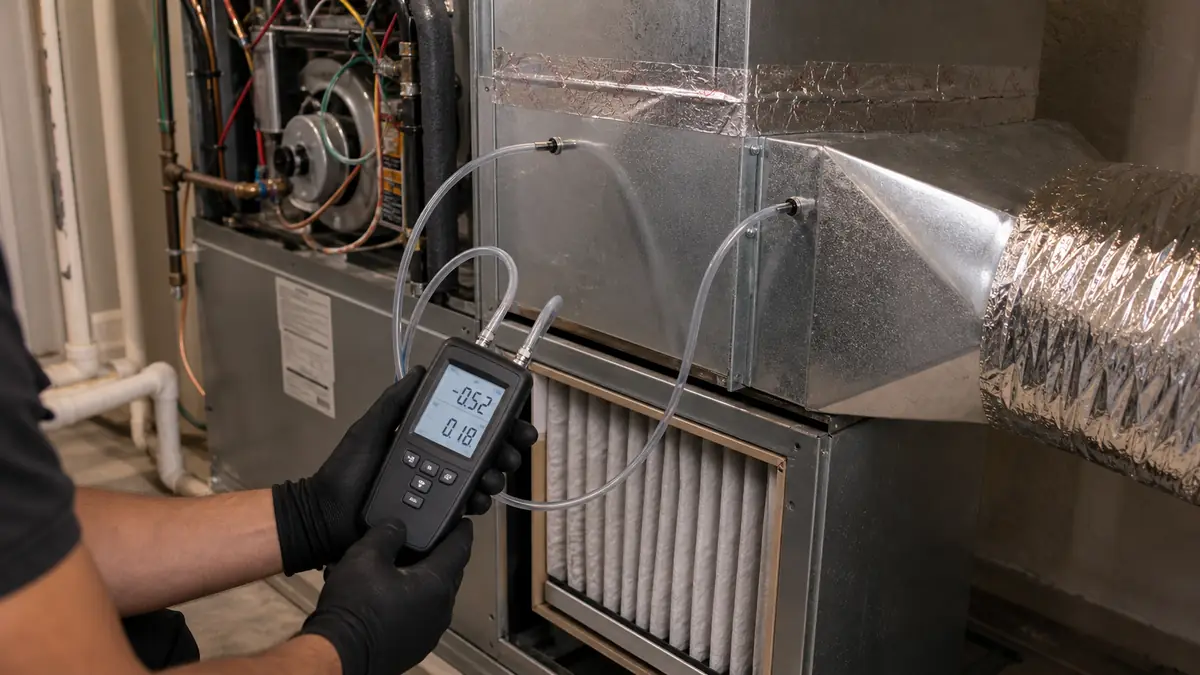
The diagnosis is a resistance measurement, not a guess. With the unit powered down, we locate the outdoor thermistors at the control board and unplug the suspect sensor at its connector. Each Mitsubishi thermistor follows a published temperature-to-resistance curve, so we read the sensor's ohms with a meter and compare it to what the curve says it should be at the current outdoor temperature - on a warm Woodland Hills afternoon a healthy sensor lands in a predictable band, while an open sensor reads infinite and a shorted one reads near zero. If the sensor is out of spec, it is the fault; if it reads correct, we move to the harness, flexing it to expose an intermittent break, and check the connector pins for corrosion. Only when a good sensor and a good harness still produce U4 do we test the outdoor board's sensor input, because that is the expensive end of the diagnosis and we do not want to land there by assumption.
What can a homeowner safely check first?
U4 leaves little for a homeowner to do safely, which is itself useful to know - it keeps you from chasing it in the heat. You can confirm the outdoor disconnect is seated and the breaker has not tripped, clear any debris or overgrowth crowding the condenser so it is not cooking even hotter, and cycle power once to see whether the code clears. If it clears and stays gone, it may have been a one-time intermittent. What you should leave to a tech is anything past the cabinet panels: the thermistors sit at the board among line-voltage terminals, and ohm-testing requires unplugging the right sensor and reading it against a curve, not eyeballing it. Because the sensors are cheap and we stock the common ones, a confirmed U4 is often resolved on the first visit rather than waiting on a part.
When should you call, and what will it cost?
Call when a reset does not hold or U4 keeps returning at the hottest part of the day - that drift is the signature of a sensor on its way out, and waiting only guarantees the condenser quits during the next heat spike across 91364, 91367, or 91371. There is no safety urgency to U4 itself, so it is a same-week visit in mild weather and a same-day visit when a home with heat-vulnerable occupants has lost cooling. On cost: a replacement outdoor thermistor or a repaired harness usually falls within a $79 to $200 diagnostic visit, while an outdoor control or inverter board, if the testing genuinely points there, runs about $400 to $2,000 installed. For how U4 fits the wider code set, see the Mitsubishi error-code reference; for a stopped condenser in a heat wave, our emergency service covers Woodland Hills, and routine sensor work goes through standard Mitsubishi AC repair.
Common questions
What does the Mitsubishi U4 code mean?
U4 means an outdoor thermistor - a temperature sensor on the condenser - reads open or shorted, so the inverter logic cannot trust its outdoor readings and shuts the unit down to protect itself. It is a U-family code, which always points at the outdoor or inverter side. The fix is usually a sensor or a harness, occasionally the outdoor control board.
Is a U4 code dangerous?
No, U4 is a protective shutdown, not a hazard - the unit stopped itself rather than run blind. The risk is comfort, not safety: during a far-western Valley heat stretch a stopped condenser means no cooling. There is no gas, fire, or shock concern with U4 itself, so it is a same-week call in mild weather and a same-day call when the home needs cooling and someone in it is heat-vulnerable.
Can a U4 code clear on its own?
Sometimes the unit will restart after a power cycle and run for a while, especially if the sensor is intermittent rather than fully failed. But an intermittent thermistor is still failing, and the code will return - often at the hottest part of the afternoon when the resistance drifts furthest. Reset once to confirm; if U4 comes back, have the outdoor sensors tested before the next heat spike.
How much does a Mitsubishi U4 repair cost in Woodland Hills?
A failed outdoor thermistor or a repaired sensor harness is a minor part and usually lands within a $79 to $200 diagnostic visit, since the sensors are inexpensive and accessible. If testing points past the sensor to the outdoor control or inverter board, that runs about $400 to $2,000 installed. We ohm the sensor against its temperature curve before condemning a board.