Mitsubishi HVAC Maintenance Plans in Woodland Hills
Cut to it: Woodland Hills Mitsubishi HVAC runs twice-yearly Mitsubishi maintenance across Woodland Hills 91364 and Carlton Terrace - coil and filter cleaning, condensate flush, flare-joint and refrigerant checks, and capacitor load tests that head off heat-wave failures. Plans start in the $89 to $200 range; call (213) 277-6575 or book online.
The rundown
- Recommended cadence: spring cooling tune-up and fall heating check, twice a year.
- Covers M-Series, MXZ multi-zone, and SVZ/MVZ ducted Mitsubishi systems.
- Drain and float testing prevents the P4/P5 leaks that damage ceilings.
- Capacitor load testing catches the most common Woodland Hills AC failure early.
- We maintain systems regardless of who installed them, across 91364, 91367, 91371.
- Stored fault history reviewed in the kumo cloud app or wired controller each visit.
- Independent and honest: we will not invent work a clean system does not need.
- Plan pricing and financing details confirmed at signup; hours Mon-Sat 7am-7pm; emergency calls anytime.
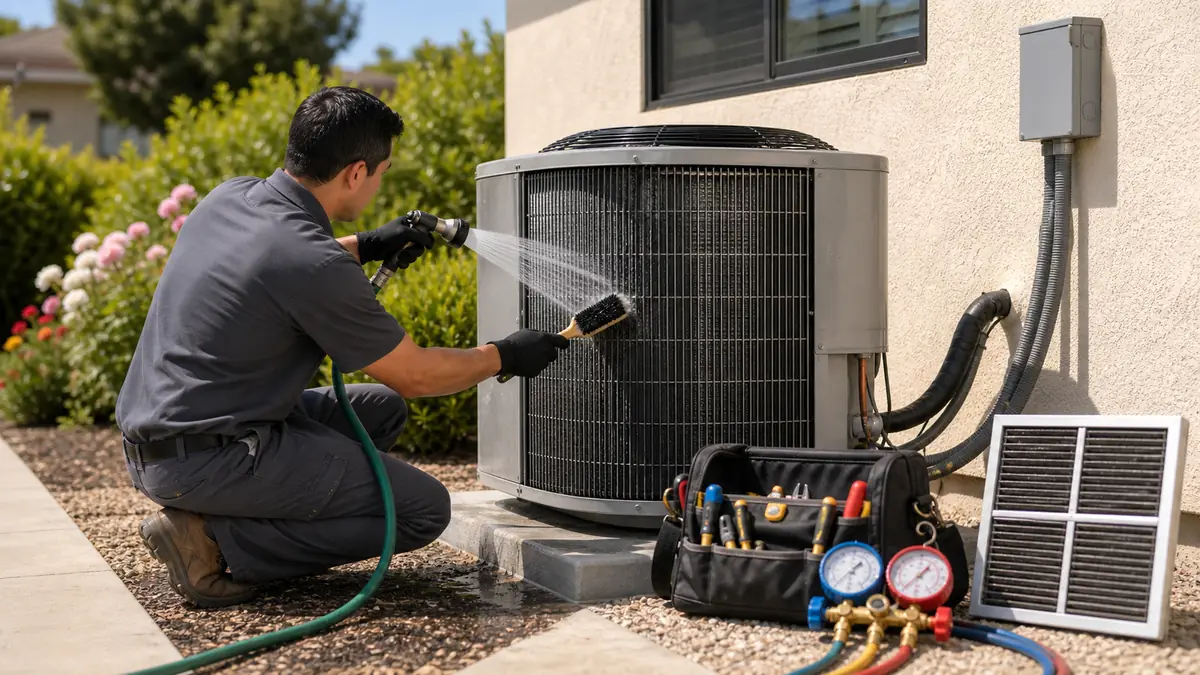
What does a Mitsubishi tune-up cover in Woodland Hills?
A ductless system has no big furnace to babysit, but it has its own wear points, and our checklist targets the ones that fail under sustained heat. We wash or swap filters and clean the indoor coil and blower wheel, because a fouled coil restricts airflow and trips P6 freezing protection. We flush the condensate drain, test the pump and float, and confirm the line has fall so it does not back up and throw P4 or P5. We inspect flare joints and check refrigerant behavior, since a slow flare leak is the quiet killer on ductless gear. And we load-test the capacitor and inspect the contactor, the two electrical parts most likely to quit in the next 100 F stretch.
| Maintenance task | What it heads off | Repair avoided |
|---|---|---|
| Coil and filter cleaning | P6 freezing, weak airflow, iced coil | $89 - $450 |
| Condensate drain flush and float test | P4/P5 water damage to ceilings and floors | $89 - $450 |
| Capacitor and contactor load test | No-cool failure during a heat wave | $150 - $450 |
| Flare-joint and charge inspection | Slow refrigerant leak, compressor stress | $225 - $1,500 |
What does a visit step through, start to finish?
A tune-up is a checklist, not a quick look. Here is the order a Mitsubishi ductless or ducted visit follows in a Woodland Hills home.
- Pull the history. We read stored fault codes in the kumo cloud app or wired controller first - a recurring P6 or U7 in the log tells us where the system has been struggling.
- Indoor airflow. Wash or replace filters, clean the indoor coil and blower wheel, and clear the vanes. A fouled coil is the leading cause of P6 freezing in this dust-heavy climate.
- Condensate path. Flush the drain, test the pump, and confirm the float and line slope so the system will not throw P4 or P5 and flood a ceiling in August.
- Refrigerant and flares. Inspect the flare joints and check refrigerant behavior; a slow flare leak is the quiet killer on ductless gear, and catching it early avoids a U7 and a stressed compressor.
- Electrical. Load-test the run/start capacitor against its microfarad rating, inspect the contactor for pitting, and verify the S1/S2/S3 inter-unit wiring is tight and corrosion-free.
- Verify and report. Run a full cooling cycle, confirm temperature split, and hand you a plain list of what was done and anything trending toward a future repair.
When in the year should each visit happen?
Two visits, timed to this climate rather than a generic calendar.
- Late winter to early spring (Feb-Apr): the cooling tune-up, done on a 70 F morning before the first 90 F stretch. This is when a marginal capacitor gets replaced cheaply instead of failing at 2 p.m. in July, and when the coil and drain get cleared before they are under load.
- Fall (Oct-Nov): the heating check, before heat-pump heating season. On Hyper-Heat systems we confirm defrost behavior and the reversing valve, and recheck the charge after a hard summer of running.
Heads in dusty hillside lots south of the Boulevard, or homes with pets, often want the indoor coils and filters cleaned a third time mid-summer, since clogged airflow is exactly what drives the freezing faults this neighborhood sees most.
Why does maintenance matter more in Woodland Hills?
Most of the country runs its AC a few weeks a year. Woodland Hills runs it for months, with 60 to 80-plus days over 90 F and a microclimate that makes it the hottest neighborhood in the city. Equipment that gets a light seasonal workout elsewhere gets hammered here, so small problems compound fast: a partly clogged filter that would be harmless in a coastal home chokes a Walnut Acres ranch into a frozen coil by July. Catching that on a 70 F March morning is the entire point of a plan.
There is an efficiency angle too. A clean, correctly charged inverter system holds its rated SEER2 and sips power during the long afternoons; a neglected one drifts down and your summer electric bill climbs. If you are weighing a newer, higher-efficiency system, see the SEER2 and rebates guide and the kumo controls page for remote monitoring that flags faults early.
Should an in-warranty system still be on a plan?
Yes, but with a clear division. Routine cleaning, drain care, and electrical checks keep a young system healthy and do not affect warranty coverage. If a covered part - a compressor or inverter board - fails on a system still inside Mitsubishi's term, that specific claim should go through factory-authorized service. We handle the upkeep and the out-of-warranty world; for the warranty line, see our approach. Need a fix instead of upkeep right now? Start at AC repair.
Common questions
How often should a Mitsubishi mini-split be serviced in this climate?
Twice a year fits the Woodland Hills load: a spring cooling tune-up before the first 90 F stretch and a fall check before heat-pump heating season. Heads in dusty hillside lots or homes with pets may want the indoor coils and filters cleaned more often, since clogged airflow is what drives P6 freezing faults.
What does a ductless tune-up actually include?
We wash or replace filters, clean the indoor coil and blower wheel, flush and test the condensate drain and pump, check the float, inspect flare joints and refrigerant state, verify S1/S2/S3 wiring, test the capacitor under load, and review stored fault history in the kumo app or controller.
Can a maintenance plan really prevent a summer breakdown?
It prevents most of the avoidable ones. Capacitors caught weak get replaced on a cool spring day instead of failing at 2 p.m. in August; drains cleared in advance do not flood a ceiling; a slow flare leak is found before the coil ices. It cannot stop a random board failure, and we say so.
Do you maintain systems you did not install?
Yes. We maintain any Mitsubishi Electric ductless or ducted system in Woodland Hills regardless of who installed it, and we will flag earlier install shortcuts - undersized line sets, sloppy flares, missing drain slope - that affect reliability in this heat.
Does maintenance keep my SEER2 efficiency from drifting?
It is the main thing that does. An inverter system holds its rated SEER2 only when the coil is clean, the filters are clear, and the charge is correct; let any of those slip and the system works harder and your summer bill climbs. A dirty coil alone can cost double-digit percentages of capacity. Twice-yearly cleaning and a charge check keep a healthy Mitsubishi running near its rating through the long Woodland Hills cooling season.
What does a maintenance plan not cover?
It covers cleaning, drain care, charge checks, and electrical testing - the wear items that fail under heat. It cannot stop a random inverter board failure or a manufacturing defect, and we say so plainly rather than imply a tune-up makes a system unbreakable. Parts repairs and replacements are quoted separately if something is found.