Repair or Replace Your AC in Woodland Hills: The Real Math
Last updated 2026-06-13.
Cut to it: Woodland Hills Mitsubishi HVAC settles the repair-or-replace question for Woodland Hills owners in 91364 with two checks - the 50% rule and the age-times-repair screen - against current 2026 SoCal pricing. The cost bands and local wrinkles are below; call (213) 277-6575 or book online.
The rundown
- 50% rule: once a repair tops half the replacement price and the unit is 10-12 years old, lean replace.
- Age-times-repair test: multiply years of age by repair cost; clear about $5,000 and lean replace.
- Capacitor or contactor: almost always repair, $150 - $450.
- Inverter compressor: $1,200 - $3,500 - often a replacement tipping point.
- Inverter / control board: $400 - $2,000+.
- Single-zone replacement $3,500 - $8,000; multi-zone $9,000 - $20,000.
- The federal 25C tax credit lapsed on 12/31/2025, with nothing available for 2026.
- LADWP and SCE heat-pump rebates cycle through funding rounds - confirm the live amounts.
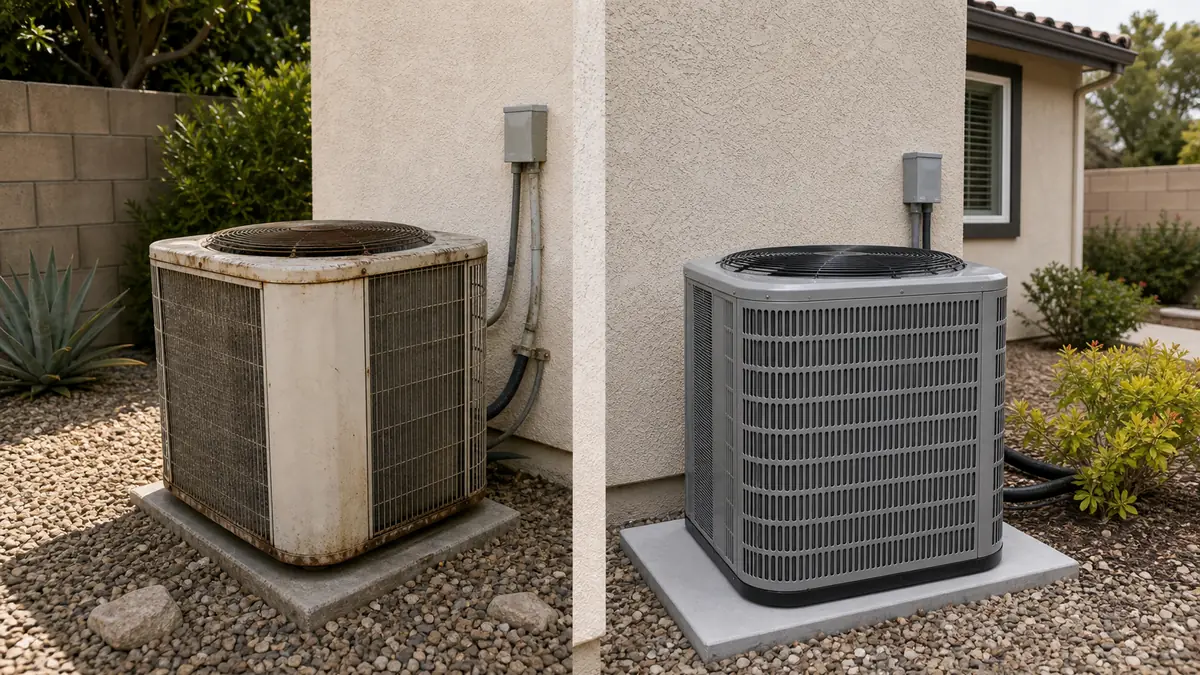
How do the two decision tests work?
No single number decides it, but a pair of fast screens gets you most of the way. Begin with the 50% rule: once a repair quote sits above roughly half the cost of a comparable new system, and the equipment has already logged 10 to 12 years, replacement usually wins - otherwise you are pouring real cash into a unit that is near the end of the road regardless. The second screen is the age-times-repair test: multiply how many years old the system is by what the repair would cost, and if that figure runs past about $5,000, lean toward replacing. A 13-year-old condenser staring at a $1,500 leak repair (13 x 1,500 = $19,500) is an obvious replace; a 5-year-old unit needing a $400 fix (5 x 400 = $2,000) is just as obviously worth repairing.
These are guides, not gospel. A meticulously maintained system, the availability of a part, and whether the failure is a one-off or a symptom of broader wear all shift the answer. Our job on site is to lay both numbers in front of you honestly rather than steer you toward the bigger ticket.
| Failure | Repair cost | Repair or replace? |
|---|---|---|
| Run/start capacitor, any age | $150 - $450 | Repair |
| Contactor, any age | $150 - $450 | Repair |
| Refrigerant leak, unit under 8 yr | $225 - $1,500 | Usually repair |
| Inverter board, unit 12+ yr | $400 - $2,000 | Lean replace |
| Inverter compressor, unit 12+ yr | $1,200 - $3,500 | Usually replace |
Three worked examples from real Woodland Hills calls
The screens are easier to trust once you see them run on actual situations. These are illustrative composites built from the kind of work we do across 91364, not specific customers.
Example 1 - the easy repair. A 6-year-old MUZ-FS09NA single-zone condenser in Walnut Acres will not start on a 99 F afternoon; the head buzzes, the outdoor fan tries and stops. Diagnosis is a failed run/start capacitor, a $150 to $450 fix. Age-times-repair is 6 x 400 = $2,400, far under the $5,000 line, and the repair is nowhere near half the replacement cost. Verdict: repair, no hesitation. The system has years left.
Example 2 - the clear replace. A 14-year-old single-zone system in Vista de Oro logs U7 and P8, and the leak is at a corroded flare on a long line run plus a tired inverter board. Quoted repair: $1,500 leak and recharge plus a $1,200 board, about $2,700. Age-times-repair is 14 x 2,700, which blows past $5,000 immediately, and $2,700 is well over half the $3,500 to $8,000 cost of a fresh single-zone install. Verdict: replace, and use the moment to step up to a higher-SEER2 inverter that will cost less to run all summer.
Example 3 - the judgment call. An 11-year-old multi-zone MXZ system south of the Boulevard has one dead head and a healthy outdoor unit and refrigerant circuit. Replacing the single failed indoor head is a few hundred dollars of parts plus labor, not a whole-system swap. Age-times-repair stays modest, and because the expensive components are fine, a targeted repair wins even though the system is over a decade old. Verdict: repair the head; revisit the whole system only when the outdoor unit or compressor fails.
| Example | Age x repair | Repair vs replace cost | Verdict |
|---|---|---|---|
| 6-yr capacitor | 6 x $400 = $2,400 | Well under half | Repair |
| 14-yr leak + board | 14 x $2,700 (over $5k) | Over half | Replace |
| 11-yr single head | Low (part only) | Far under half | Repair the head |
What tends to fail first in this heat?
Knowing the usual failure order helps you read your own situation. In Woodland Hills the run/start capacitor is the first casualty - it is an electrolytic part that degrades faster the longer and hotter the compressor runs, and a neighborhood that logs 60 to 80-plus days a year over 90 F cooks them early. Contactors pit and weld from the same heavy cycling. Next come refrigerant leaks at flare joints, which weep slowly as thermal expansion and contraction work the connections loose over years. Inverter and control boards fail later, often after years of voltage stress and heat soak in an outdoor cabinet. The compressor is usually last, and when an inverter compressor goes on a 12-plus-year unit, that is the failure that most often tips a home into replacement. The pattern matters for the decision: an early-life capacitor or contactor is always a repair, while a late-life board or compressor is where the age-times-repair math earns its keep.
How does Woodland Hills change the calculation?
Climate tilts the math toward replacement sooner here than almost anywhere in the basin. Because the Santa Monica Mountains trap heat and make this the hottest neighborhood in the City of Los Angeles, a system runs hard for 60 to 80-plus days a year over 90 F. That sustained load both wears equipment faster and raises the value of efficiency. An old single-stage condenser that short-cycles all afternoon is expensive to run for months; a modern modulating Mitsubishi inverter that holds partial capacity is far cheaper to operate over the same season. So replacing a tired unit in Woodland Hills pays back faster than the same swap in a coastal ZIP that only cools a few weeks a year.
Housing stock matters too. A lot of Walnut Acres and Vista de Oro homes are mid-century ranches whose original ductwork is undersized, so a replacement is often the moment to fix airflow with a ducted SVZ or MVZ system or to go ductless and skip the bad ducts entirely. On the hillsides south of Ventura Boulevard, replacement is frequently paired with zoning so the hot upper floor finally gets dedicated capacity.
What does a replacement cost, and what do you get?
| Replacement | Typical install | Best for |
|---|---|---|
| Single-zone ductless (MSZ/MUZ) | $3,500 - $8,000 | One hot room or addition |
| Hyper-Heat single-zone | $4,500 - $8,000 | Top efficiency, electrification |
| Multi-zone (MXZ-SM, 3-4 zones) | $9,000 - $20,000 | Whole home, per-room control |
| Ducted inverter (SVZ/MVZ) | $6,000 - $14,000 | Keep ducts, central comfort |
A new inverter system buys you efficiency, quiet, even temperatures, and the option of zoning. It also resets the warranty clock and ends the cycle of feeding repairs into aging equipment. The Hyper-Heat page covers the heat-pump path, and the Manual J sizing guide explains why we size carefully instead of upselling tonnage.
What about rebates and tax credits?
Incentives can take some sting out of a replacement, but you have to pin them down at purchase because the rules keep moving. The federal Energy Efficient Home Improvement Credit (Section 25C), once good for 30% of project cost up to $2,000 on a heat pump, was repealed effective December 31, 2025 - eligibility stops with gear bought and installed on or before that day, which means a 2026 install gets no federal 25C credit at all. Closer to home, LADWP's heat-pump rebate has been reported reaching $2,500 per ton on qualifying high-efficiency systems, and SCE has paid roughly $1,000 per qualifying heat-pump HVAC system, though both cycle through funding rounds that pause and reopen. TECH Clean California, the statewide program, had its single-family funds reported fully reserved in early 2026. SoCalGas, meanwhile, carries furnace and smart-thermostat rebates on the gas side.
The bottom line for a Woodland Hills owner: pull up the current dollar amount and the open-or-closed status straight from the program's own page before you count on it, and do not let a unit sit dead through a Valley heat wave just to wait on a rebate. The SEER2 and rebates guide digs further into efficiency tiers and the program specifics.
And if the unit is still under warranty?
If your Mitsubishi is young enough to be inside its parts-and-labor warranty and the failure is a covered part like a compressor or inverter board, start with factory-authorized service so the claim is honored - replacing it out of pocket would waste real coverage. We are independent, so we handle out-of-warranty repair, replacements, retrofits, and second opinions on big quotes. See our approach for how we draw that line, and start any active repair at AC repair.
Common questions
What is the 50 percent rule for AC replacement?
When the fix would run past about half of what a comparable new system costs, and the equipment has already reached 10 to 12 years old, putting that money toward a replacement is usually the wiser call. A repair only borrows time on tired gear; a new inverter restarts the lifespan and trims the long Woodland Hills summer bill on top of it.
How old is too old for a Mitsubishi system?
Well-maintained inverter systems often run 12 to 18 years, but our heat shortens that. By 12 to 15 years a single-zone condenser facing big-ticket repairs - compressor, inverter board - is usually worth replacing rather than pouring money into. A 6-year-old unit with a bad capacitor is an easy repair, no question.
Will a new system really lower my electric bill?
In Woodland Hills, where cooling runs for months, the efficiency jump from an old single-stage unit to a modern inverter is meaningful. A modulating Mitsubishi holds its SEER2 rating and runs at partial capacity most of the day instead of slamming on and off. The savings are real but vary with usage, so we will not promise a specific dollar figure.
Can I replace just one part of a multi-zone system?
Often yes. On an MXZ or MXZ-SM you can replace a single failed head or branch component without scrapping the whole system if the outdoor unit and refrigerant circuit are healthy. We always check whether a targeted repair beats a full replacement before quoting the big number.
Is it worth replacing before a rebate program reopens?
Possibly, but check the facts first. The LADWP and SCE heat-pump rebates move through funding rounds that close and reopen, and the federal 25C tax credit lapsed at the end of 2025. Do not let a dying system limp through July on the hope of an incentive; if you have no cooling in this heat, repair or replace now and treat any rebate as a bonus you verify before banking on it.