Weak Airflow on the South-of-the-Boulevard Hillsides
Cut to it: Woodland Hills Mitsubishi HVAC fixes weak Mitsubishi airflow on the hillside homes south of Ventura Boulevard in Woodland Hills 91364, where stacked floors and long duct runs starve the hot upper level. We diagnose ducts, blower, and zoning from $89 to $20,000; call (213) 277-6575 or book online.
The rundown
- Hillside, multi-level plans add static pressure and starve upper floors.
- Sun-baked top floors sit farthest from the air handler - worst-case airflow.
- Common fix: zoning with a multi-zone MXZ-SM, one zone per level.
- Long line sets carry more refrigerant and more flare joints to keep leak-free.
- ECM blower or duct limits diagnosed by measuring static pressure.
- Under Title-24 in Zone 9, altering ducts can call for HERS-verified duct sealing.
- Service area 91364 south of Ventura Boulevard; independent diagnosis.
- Cost lanes: coil clean $89 - $450; ECM blower $450 - $2,300; ducts $1,900 - $6,000.
Why is airflow worse on these hillside homes?
The homes climbing the slopes south of Ventura Boulevard share a problem that flat tracts do not. They are often multi-level, with the living space stacked up the hillside, and that punishes airflow. Long vertical duct runs and the extra elbows needed to route them add static pressure, so the blower has to work harder to push air to the far rooms. The cruel part is that the upper floor - the one that bakes hardest in the afternoon sun in a neighborhood that is already the hottest in the city - is usually the farthest from the air handler and the first to go starved. You feel it as a cool downstairs and a stubborn, hot upstairs that the system never quite satisfies.
Layer the usual suspects on top of that geometry and it compounds. A fouled coil or a loaded filter that a single-story ranch would shrug off pushes a tall, duct-stressed home over the edge. Original ductwork on an older hillside house may never have been sized for the upper-floor load. We measure static pressure to separate an equipment problem from a duct-design problem before recommending anything.
What actually fixes it?
| What you see | Likely cause / fix | Cost lane |
|---|---|---|
| Whole house weaker than it was | Coil and filter cleaning | $89 - $450 |
| Weak at every register, ducted | ECM blower motor or module | $450 - $2,300 |
| Downstairs fine, upstairs starved | Duct design limit; zoning or duct work | $1,900 - $6,000 |
| Upstairs never cools enough | Add a dedicated zone (MXZ-SM) | $3,500 - $20,000 |
The cleaning and blower fixes are straightforward. The structural answer on a stubborn hillside home is usually zoning: a multi-zone MXZ-SM system with a head or ducted handler dedicated to the hot upper floor, so that level gets its own airflow instead of losing the tug-of-war with the cool downstairs. The general airflow mechanics are covered on the weak airflow page, and the Manual J sizing guide explains why we calculate per-zone loads rather than guessing.
How do we measure the real bottleneck?
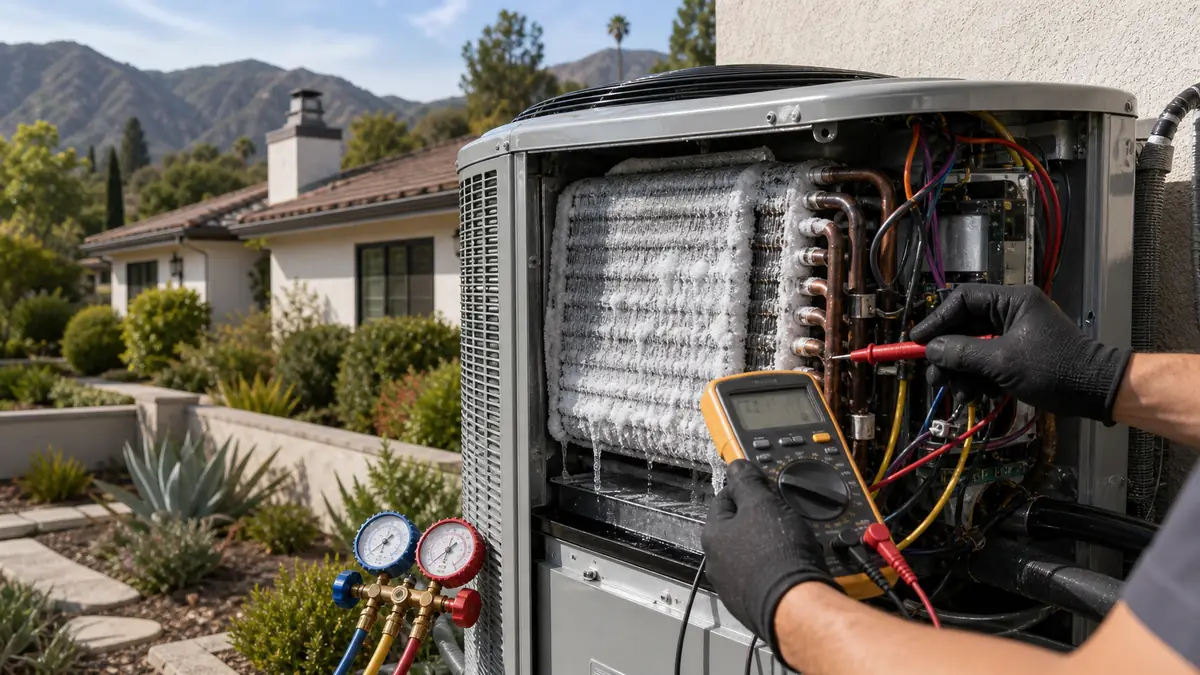
On a stacked hillside home the guesswork is expensive, so we measure. We put a manometer on the return and supply trunks to read total external static pressure, then compare it to the air handler's rated maximum - a number well over spec means the ducts, not the equipment, are the limit, and adding a bigger blower would only push harder against the same restriction. We map the run: vertical rise, elbow count, and trunk size up to the starved upper floor. We check the ECM blower's commanded versus actual speed, inspect the coil and filter, and read any stored code, since a badly choked coil eventually ices and logs P6 freezing protection. Only with those readings in hand do we say whether a cleaning, a blower repair, a duct rework, or a dedicated upper-floor zone is the honest answer. That keeps homeowners on these lots from paying for a fix that the duct geometry was always going to defeat.
Do you handle the steep-lot access?
Yes - tiered and side-yard condenser placements and long line sets are standard on these lots, and we plan for them. For nearby sloped-edge homes see Carlton Terrace, and if a coil has already iced from the restriction, start at frozen evaporator coil.
Common questions
Why do hillside homes south of the Boulevard get weak airflow?
Multi-level floor plans on steep lots fight airflow on two fronts. Long, tall duct runs and many turns add static pressure, and the upper floors that bake in the afternoon sun sit farthest from the air handler. Add a fouled coil or undersized original ducts and the top of the house ends up starved while the bottom is fine.
Is the fix different on a hillside home?
Often, yes. On a flat ranch a coil cleaning usually settles it. On a stacked hillside home we frequently find the real limit is duct design or capacity, and the better answer is zoning - a multi-zone MXZ-SM with a head or ducted handler per level - so the hot upper floor gets its own dedicated airflow instead of competing for it.
Can you reach condensers on these steep lots?
Yes. Side-yard and tiered placements are normal here, and we plan line-set length and access before the job. Longer runs mean more refrigerant and more flare joints to keep leak-free, which we account for in both repair and install pricing.